Protection for emigrants along the Oregon Trail was the motivation for the U.S. government to establish Fort Laramie near the eastern edge of the Wyoming Territory in 1849. The fort was jump-started with the purchase of buildings from the American Fur Company, which had maintained a trading post along the banks of the Laramie River.
According to the National Park Service:
Major W. J. Sanderson with 4 officers and 58 men of Company E left Fort Leavenworth early in May and arrived at the Laramie on June 16 without incident. On June 27 he reported to the adjutant-General that after making a thorough reconnaissance within a radius of 75 miles of the trading post he had found this to be the most eligible site and that at his request Lieutenant Woodbury had, on June 26, purchased Fort Laramie from Bruce Husband, agent of the American Fur Company, for $4,000.
On June 22 Major Osborne Cross and Private George Gibbs, with a contingent of Mounted Riflemen en
route to take over Fort Hall on Snake River, in present Idaho, paused at Laramie Fork where they found
Company E encamped opposite the adobe fort while Woodbury was scouting the territory. Both thought the situation there "forlorn and destitute of interest." However, Sanderson reported that good timber, limestone, hay and dry wood were readily available and that the Laramie River furnished abundant good water for the command.Company C, Mounted Rifles, consisting of 2 officers and 60 men, arrived at the post on July 26. On August 12 the two officers and 53 men of Company G, Sixth Infantry, completed the garrison and joined in the work of preparing quarters. While purchase of the adobe post provided the Army with temporary shelter for men and supplies, it was decrepit and infested with vermin. Before the ink was dry on the purchase agreement Sanderson had the entire command employed in cutting and hauling timber and burning lime. Stone was quarried and a horse-powered sawmill placed in operation. By winter a two-story block of officers quarters, a block of soldier quarters, a bakery, and two stables had been pushed to completion. Thus began Fort Laramie's forty years as a frontier command post of the United States Army.
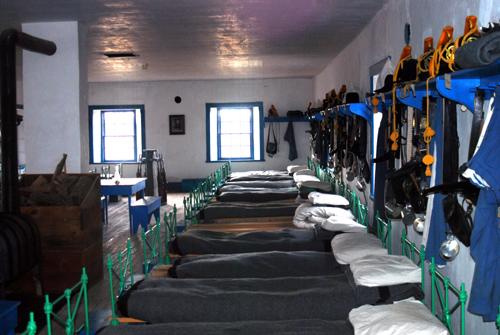
Today a small handful of the fort's buildings remain, along with the ruins of many others. Among those still standing and worthy of a tour to get a feel for military life on the 19th century frontier are "Old Bedlam," the bachelor officers' quarters that is recognized as the oldest "documented" building in Wyoming, having been built in 1849, and the barracks.


Add comment