
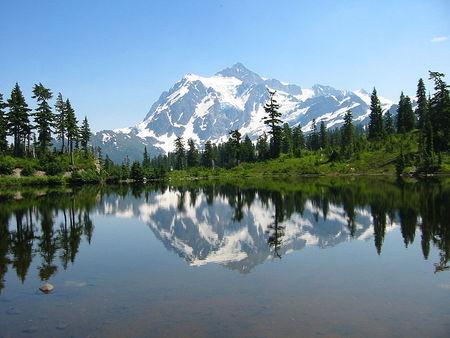
1. Look at the photo accompanying this quiz. This gorgeous glaciated peak is Mount Shuksan, which is said to be one of the world’s most photographed mountains. The aptly named lake in the foreground is Picture Lake. Picture Lake is on Mount Baker, and Mount Baker is a volcano in a mountain range that consists of volcanic peaks. From this you should be able to deduce that the mountain in the photograph is in
a. Lassen Volcanic National Park
b. Mount Rainier National Park
c. North Cascades National Park
d. Wrangell-St. Elias National Park
2. You’ll need to climb Mount McKinley if you yearn to stand atop the highest mountain in America’s National Park System (or in North America, for that matter). If you want to stand atop the second highest mountain in our national parks, you’ll need to go climb
a. Mt. Whitney
b. Mt. Logan
c. Mt. St. Elias
d. Mt. Adams
3. It is just shy of being the highest mountain on earth, measured base to peak, but ______ is definitely the highest mountain in a Hawaiian national park.
a. Muana Loa
b. Mauna Kea
c. Haleakala
d. Kilauea
4. The National Park Service did not own any land in the authorized boundaries of ______ until several years after the national park had been established.
a. Kennesaw Mountain National Battlefield Park
b. Catoctin Mountain Park
c. Santa Monica Mountains National Recreation Area
d. Guadalupe Mountains National Park
5. Each of the following is a true statement about the Mount Rushmore National Memorial EXCEPT: (Choose the one that “does not belong.”)
a. Work on the memorial construction project began in 1922.
b. An executive order placed the memorial under National Park Service jurisdiction in 1933.
c. The memorial construction project was declared complete in 1941.
d. Gutzon Borglum, the sculptor who started the project, died before it was completed.
6. Gates of the Arctic National Park and Preserve, which is actually counted as two separate national parks, is about the size of Switzerland. Within the boundaries of Gates of the Arctic are extensive portions of the
a. Brooks Range
b. Alaska Range
c. Coastal Mountains
d. Chugach Mountains
7. A cog railway once delivered visitors to the top of ______, a prominent landscape feature of one of eastern America’s most popular national parks.
a. Mount Washington
b. Cadillac Mountain
c. Clingmans Dome
d. Mount Mitchell
8. Each of the following is a true statement about the Olympic Range in Olympic National Park EXCEPT: (Choose the one that “does not belong.”)
a. There are glaciers and glaciated valleys in the mountains.
b. The mountains have some plant and animal species found nowhere else in the world.
c. The western flanks of the mountains record some of America’s highest annual precipitation.
d. The eastern flanks of the mountains are covered with a temperate rainforest.
9. Which park is situated in a mountain range that consisted of massive, snow-capped peaks (some as high as mountains in the Andes or Himalayas) about 300 million years ago?
a. Yosemite National Park
b. North Cascades National Park
c. Rocky Mountain National Park
d. Shenandoah National Park
10. The western slope of the highest mountain in the coterminous 48 states is in
a. Yosemite National Park
b. Mount Rainier National Park
c. Sequoia National Park
d. Kings Canyon National Park
Extra credit
11. The Lewis Overthrust Fault has not only shattered vast quantities of rock, it has also created “rootless mountains” by moving great masses of rock many miles from where they were formed. One such rootless mountain is Chief Mountain in
a. Glacier National Park
b. Great Smoky Mountains National Park
c. Zion Canyon National Park
d. Guadalupe Mountains National
Super bonus question
12. The first Europeans to acquire intimate knowledge of the Rocky Mountains were the mountain men, trappers and explorers who roamed the western mountains and trapped beaver from about 1806 to the early 1840s. The first mountain man to see the area now preserved as Yellowstone National Park was ______, who visited that part of the central Rockies during the winter of 1807-1808.
a. Jedediah Smith
b. John Colter
c. Kit Carson
d. Jim Bridger
Answers: (1) c (2) c (3) a (4) c (5) a (6) a (7) b (8) d (9) d (10) c (11) a (12) b - Many historians consider John Colter, who was a member of the Lewis and Clark expedition (1804-1806), to be the first mountain man.
Grading: 9 or 10 correct, rest on your laurels; 7 or 8 correct, pretty darn good; 6 correct, passably fair; 5 or fewer correct, nothing to brag about.



Comments
Finally, I get to rest on my laurels - 9 of 10 (but missed both bonuses). I was about to enroll in GEOG 370 after the last several quizzes.
The question about Mt. Whitney's western slope being in a park got me thinking about how many actual state high points are within national parks. Seems like a surprisingly low number. I count six, with five in national parks and one in a national recreation area. Anyone want to see if I'm correct? I had to have missed a couple.
I also counted five contained in the national parks themselves: TX, CA, WA, TN and AK. Not totally surprising considering many state high points are just that - high points - and not true mountains or significant features.
...with Virginia's Mt. Rogers in an NRA. You're right about the high points. I wouldn't expect a slight rise in western Kansas or a little bump in Florida to be a national park. I just would have thought states like MT, ID, CO, AZ, NM, SD, OR, NV, UT, etc. would have more of their high points just by chance fall into an NPS area.
Technically, the summit of Whitney isn't in Sequoia NP - as per number 10 above, so California doesn't even count. I had NC in my original count because for some reason I was putting Mt. Mitchell in GSMNP.
12 for 12!