
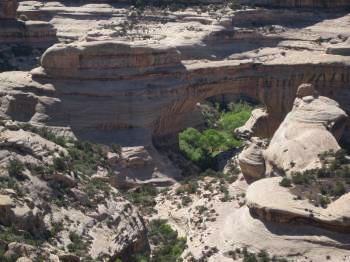
You were given these clues to work out the identity of Mystery Spot 41, a natural feature in a national park.
How do you make a long story shorter?
What is the holy hole in the floor?
What was the player who wrecked the lights and delighted the Knights?
Which park contains just one more than the McDonald’s logo?
The answer is Sipapu Bridge, largest of the three natural bridges preserved in Utah’s Natural Bridges National Monument. At 268 feet long and 220 feet high, this enormous white sandstone arch ranks as the world’s second-largest natural bridge (only Glen Canyon’s Rainbow Bridge is bigger). Like the park’s other two natural bridges, Owachomo and Kachina, Sipapu was named in honor of the Hopi, Native Americans who trace their roots to Ancestral Puebloans who inhabited the Colorado Plateau region for thousands of years.
Here is how the clues lead you to the answer:
The small hole in the floor of a Pueblo Indian kiva, a ceremonial chamber traditionally built wholly or partly underground, is called a sipapu. That’s because the hole symbolizes Sipapu, a mythological opening in the earth surface which, according to Hopi oral tradition, was used by tribal ancestors who emerged from the underworld to inhabit the earthly world. A sipapu may also signify a gateway through which souls enter the spirit world.
The player who “wrecked the lights to the delight of the Knights” was a natural, an athlete suited by nature to excel at his sport. In the climactic scene of the 1984 classic film The Natural, Roy Hobbs (Robert Redford) lofts a baseball into a light stand atop the stadium roof, wrecking the lights and producing sparks that light up the night sky like fireworks. This mammoth walk-off home run in the bottom of the ninth wins the pennant for his team, the Knights.
You abridge a long story when you shorten it.
Natural Bridges National Monument has three arches, which is one more than the iconic McDonald’s "golden arches" logo.
Congratulations to the Traveler readers who figured this one out: Slaney, Eric, viewmtn, Eric Nelson, celbert, RangerLady, ILoveRoadTrips, Low Cro, David Crowl, and sukisherwood. All have qualified for our monthly prize drawing.


Comments
...Sound of fingernails scraping across a chalkboard... ("across a whiteboard" simply doesn't give the same effect)
As copied from http://www.nps.gov/rabr/faqs.htm:
What is the difference between a bridge and an arch?
A bridge crosses or “bridges” a watercourse; a stream, river, or any body of flowing water, at least intermittently. An arch does not have active water flowing underneath it. Bridges and arches are both formed primarily by water-based weathering and erosion. Arches often form within the apex of a rock alcove whereas bridges evolve from erosion within a stream channel.
A natural bridge is an arch because of its shape. When origin or position is taken into account, a natural bridge is a water-formed subtype of natural arch. The Natural Arch and Bridge Society does not equivocate on the matter, stating that "A natural bridge is a type of natural arch."
Boy, I'm glad you cleared that up! Although, I do recall a ranger at Natural Bridges Nat. Mon. who said do not call them arches!
We're splitting hairs here. I've always thought of "arches" and "natural bridges" as being basically synonymous terms. Besides, how do we know the Mc Donald's logo wasn't formed by two magical streams of milk shake and thus consists of two natural bridges?
Kidding aside, Bob never said "arches" specifically in any of his clues, although the McDonald's one kind of implied it. But he did specifically imply "natural" and "bridged" with two clues, so he tried to put everyone on the right track. And I've learned it doesn't pay to be too technical on the clues, as on the Navajo Reservation time zone thing I allowed to mess me up a few weeks back.
Celbert makes a good point. The first three clues supplied the identity of the mystery spot, and none of these required you to know that a natural bridge is a type of natural arch.
I understood all except the second clue, but there was no way I was going to come up with the name. Well - I was actually thinking how Roy or Hobbs fit into the answer.