Richard West Sellars
About
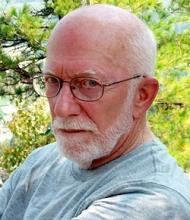
Richard West Sellars is a retired National Park Service historian and author of Preserving Nature in the National Parks: A History (Yale University Press, 1997, 2009). This book inspired the Natural Resource Challenge, a multi-year initiative by Congress to revitalize the Park Service’s natural resource and science programs. The Challenge made possible what Stewart Udall, former secretary of the interior, called “the greatest advances in scientific natural resource preservation in the history of the national parks.”
Currently, Dr. Sellars is preparing a personal retrospective—a policy memoir—of his 35-year career with the National Park Service, focused on his observations of the Service’s history and its policies and practices in cultural and natural resource management. He also has underway a companion study to Preserving Nature – a history of evolving policies and practices in the management of historical and archeological areas in the National Park System. Portions of this study have been published as Pilgrim Places: Civil War Battlefields, Historic Preservation, and America’s First National Military Parks, 1863-1900, (Eastern National Press, 2005); and A Very Large Array: Early Federal Historic Preservation–The Antiquities Act, Mesa Verde, and the National Park Service Act, Natural Resources Journal (University of New Mexico School of Law, Volume 47, no.2, 2007). His most recent publication is War and Consequences: The American Indian Movement vs. the National Park Service at Fort Laramie, which appeared in National Parks Traveler, and a slightly abridged version in Indian Country Today, both in the spring of 2011.
Sellars began his career with the National Park Service in the mid-1960s as a seasonal ranger-naturalist in Grand Teton National Park. In October 1973 he accepted a position in the Southwest Regional Office in Santa Fe, New Mexico. He spent the remainder of his Park Service career in Santa Fe, although his research, writing, teaching and other work have, in one way or another, involved virtually the entire National Park System. From 1979 to 1988, Sellars oversaw programs in history, archeology, and historic architecture for the Southwest Region, as well as Service-wide programs in underwater archeology. Special assignments have included acting superintendent in parks; and a liaison consultancy with the Dallas County Historical Foundation on preservation and interpretation of the Texas School Book Depository and Dealey Plaza, in Dallas, Texas, site of the assassination of President John F. Kennedy. He has more than 370 of the 390+ units of the National Park System.
Sellars' articles on American history and on cultural and natural resource preservation have appeared in numerous publications, among them The Washington Post, Wilderness, National Parks, Journal of Forestry, and Landscape. He has lectured on preservation philosophy, policy and practice at many universities and conferences, and for more than a decade conducted two-week courses in historic preservation for National Park Service managers. He has given presentations at a number of special meetings, including the Thomas Moran Symposium at the National Gallery of Art, Washington, D.C.; Abraham Lincoln 197th Birthday Commemoration, Springfield, Illinois; the Greater Yellowstone Coalition Conference, West Yellowstone, Montana; and the Mesa Verde Centennial Archeological Conference, 2006 (keynote address).
Sellars is a recipient of the Department of the Interior’s Meritorious Service Award; the Coalition of National Park Service Retirees’ George B. Hartzog Award; and the George Wright Society’s highest honor: the George Melendez Wright Award for Excellence, given for career-long contributions.
In 1999 and 2000, Sellars served as president of The George Wright Society – an internationally focused organization dedicated to the preservation of natural and cultural parks and preserves. For two years he was a member of the National Park Service's National Wilderness Steering Committee. He also spent two terms on the board of the Forest History Society, and served on the Historic Design Review Board for the City of Santa Fe. In 1972 he received his doctorate in American history and literature from the University of Missouri-Columbia.
Picture

Support Journalism about National Parks!
National Parks Traveler is a 501(c)(3) nonprofit.
The Essential RVing Guide
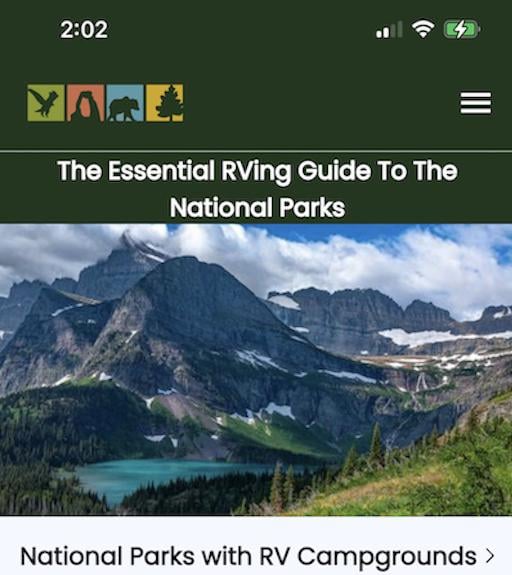
The National Parks RVing Guide, aka the Essential RVing Guide To The National Parks, is the definitive guide for RVers seeking information on campgrounds in the National Park System where they can park their rigs. It's available for free for both iPhones and Android models.
This app is packed with RVing specific details on more than 250 campgrounds in more than 70 parks.
You'll also find stories about RVing in the parks, some tips if you've just recently turned into an RVer, and some planning suggestions. A bonus that wasn't in the previous eBook or PDF versions of this guide are feeds of Traveler content: you'll find our latest stories as well as our most recent podcasts just a click away.
So whether you have an iPhone or an Android, download this app and start exploring the campgrounds in the National Park System where you can park your rig.
